
Bronze Street Review
24 July 2026Where precision meets personality, music becomes art.
Jamali return with Ohema. Not to relive the past, but to continue the conversation.
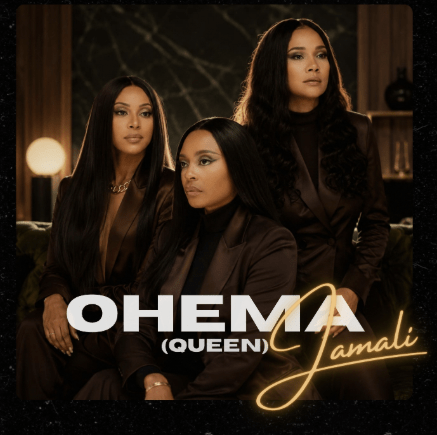
There comes a point in a woman's life when being called a queen should no longer be enough.
Not because the word has lost its beauty.
Because she has lived long enough to know what it costs.
That is the tension sitting underneath Ohema, the first new Jamali single after thirteen years away from the recording studio as a trio.
Jacqui Carpede, Mariechan Luiters and Liesl Penniken don't need an introduction to South African music.
That is precisely why Ohema deserves more than applause for their return.
It deserves to be listened to properly.
Twenty-three years is not nostalgia
Jamali began through Coca-Cola Popstars in the early 2000s and did something far more difficult than appearing on television.
They survived television.
There is a difference.
Reality competitions manufacture recognition quickly.
They are considerably less successful at manufacturing careers.
Jamali built one.
Love Me For Me.
Butterflies.
Secrets.
Dalile.
Knowing Me Knowing You.
Albums, radio, stages, nominations, a SAMA, and eventually the kind of catalogue that begins belonging as much to the public as to the people who recorded it.
By 2013, Toxic Candy had become their last studio album before the long silence.
The women didn't vanish.
They lived.
Solo work happened.
Families happened.
Careers happened.
The industry itself became almost unrecognisable.
The record store gave way to the platform.
Albums became content.
Radio surrendered part of its authority to playlists, feeds and fifteen-second decisions.
Then, after thirteen years, they walked back into a studio together.
Jacqui has described the old vocal relationship as almost muscular memory.
Liesl still knows where her high harmony belongs.
Mariechan and Jacqui know instinctively when to occupy the melody and lower register.
After this long, they don't have to negotiate being Jamali.
Their voices already know.
That may be the most beautiful thing about Ohema.
Three people can spend years apart and still find the chord.
Eldorado Park
There is another reason I can't pretend complete distance from this record.
One part of the Jamali story comes from Eldorado Park.
So do I.
Jacqui Carpede grew up there, in the south of Johannesburg, long before television made her recognisable.
Contemporary profiles were already identifying Eldorado Park as home when she entered Popstars.
Places like ours notice when somebody gets out into the world.
Not because success belongs to the place.
Because we know the distance.
We know how far a stage can look from an ordinary street.
So there is affection here.
There is also no point pretending affection makes a record better.
If anything, it makes me want more from it.
These are not three young singers asking South Africa to give them a chance.
They are women who earned one a long time ago.
That changes the standard.
A queen according to whom?
Ohema, more commonly rendered Ohemaa, comes from Akan and means queen or female monarch.
The song builds its story around a charming African man attempting to win a woman over, flattering her, admiring her and positioning her as his queen.
The group have described the lyric as a playful conversation between women about that familiar kind of smooth operator.
It is light.
It is charming.
It works.
And I wanted more.
Not more words.
More truth.
Because queen is no longer an innocent word in popular culture.
We have emptied it through repetition.
Queen.
King.
Boss.
Legend.
Icon.
We hand these words out so casually that sometimes they stop describing anything at all.
But three women entering their forties after surviving more than twenty years in the South African music business have actually earned the right to investigate that word.
What does queenship mean after the applause?
What does it mean when the body changes?
When beauty is no longer something you are waiting to acquire but something you have had to redefine?
What does it mean after motherhood, disappointment, private failure, money, men, ambition, friendship, resentment, forgiveness, distance and the strange experience of watching younger women arrive in an industry you once represented?
What does a queen know at forty that she did not know at twenty-one?
That is the song I kept hearing behind this one.
And Ohema doesn't quite go there.
The man in the song
There is something particularly interesting about building the record around a man declaring the woman a queen.
At twenty, perhaps that is romantic.
At forty, I want to know whether she believes him.
That is where the lyric could have become dangerous.
Let him talk.
Let him arrive with the charm.
Let him tell her she is magnificent.
Then let these women answer him from twenty-three years of living.
Maybe she laughs.
Maybe she has heard it before.
Maybe she wants him anyway.
Maybe being wanted still feels good and she is old enough not to apologise for that.
Maybe she knows the difference now between being adored and being known.
Maybe queenship has absolutely nothing to do with him.
There is an entire second song hiding inside that tension.
Instead, Ohema stays pleasant.
That is not an insult.
Pleasure has value.
Flirtation has value.
Not every record needs to carry a thesis into battle.
But when the title is Queen, and the women singing it have actually had to become women in public, I can't help wanting the lyric to remove its jewellery for a moment.
Sit down.
Tell me something.
Three voices that still know each other
The encouraging part is the voices.
That Jamali identity remains.
It isn't merely three singers occupying the same recording.
Their usefulness as a group has always lived in the relationship between the voices.
There is a reason vocal groups become rare as singers mature.
Individuality gets stronger.
Taste becomes more specific.
Life teaches everyone to protect their own space.
Harmony requires the opposite.
Somebody has to move.
Somebody has to sit underneath.
Somebody has to stop demonstrating and support the note above them.
Liesl has spoken about knowing instinctively that she will take the higher parts, while Jacqui and Mariechan move between melody and lower harmony.
That sounds like technical information until you have spent enough time making records.
Then you understand what it really means.
Trust.
You cannot manufacture twenty-three years of knowing where another person's voice is about to go.
That is the human element Ohema already possesses.
Which makes my problem with the production more frustrating.
Where are the fingerprints?
The production works.
That isn't the same as saying I love it.
The record sits comfortably inside contemporary Afro-pop and Afrobeats language.
That direction was deliberate.
Jamali have said that Full Circle explores several current sounds, with Ohema occupying the Afrobeats side while still carrying their R&B identity.
You can hear the intelligence in that decision.
The groove knows where it lives.
The percussion is tidy.
The frequencies behave.
The vocals occupy their spaces.
The production understands contemporary listening.
Perhaps a little too well.
I kept wanting somebody to touch the thing.
Not operate it.
Touch it.
A bass player leaning into a note because the singer did something unexpected.
A percussionist arriving several milliseconds late because human beings do that.
A keyboard voicing that makes no theoretical sense but makes emotional sense.
A guitar amp moving air in a room.
A breath somebody forgot to remove.
A mistake worth keeping.
Anything that tells me this happened once.
In a place.
Between people.
The problem with perfection
We are entering a strange period in recorded music.
Technical perfection has become cheap.
Anyone with a laptop can quantise.
Anyone can tune.
Anyone can move a transient.
Anyone can purchase another person's drums, another person's chords, another person's vocal chain and increasingly another approximation of another person's imagination.
The scarce commodity is becoming evidence.
Evidence that somebody was there.
I'm not making an accusation about Ohema.
I have no evidence to make one.
But the public-facing production credits do the record no favours.
Apple Music identifies the release simply as ℗ 2026 Jamali, and in interviews the group speak about connecting with different producers while developing the EP without publicly identifying who shaped this particular recording.
That kind of opacity used to be merely irritating.
In 2026 it carries a different weight.
If a record already feels highly assembled, highly controlled and strangely clean of fingerprints, an unclear production identity leaves unnecessary questions hanging in the room.
Who made this?
Who played this?
Who programmed this?
Who decided that?
These questions matter.
Credits are not decoration.
They are provenance.
And musicians who have survived as long as Jamali deserve music whose human authorship is proudly visible.
Do not compete with the children
Jamali have been candid about wanting to explore what is happening now.
That makes sense.
Mariechan has spoken about the changed industry and the need to remain adaptable.
The group deliberately wanted to experiment with contemporary sounds and find a way of carrying their R&B identity into the present.
I understand that instinct.
I just hope they don't obey it too much.
Jamali don't need to prove that they understand 2026.
They have something far more valuable.
They understand 2003, 2008, 2013 and 2026.
They have lived through the transition.
A twenty-year-old artist cannot manufacture that perspective.
This is where established artists sometimes make a strange mistake.
They enter the contemporary marketplace and begin borrowing youth when youth should be borrowing from them.
Jamali should absolutely hear what younger producers are doing.
Steal from them.
Learn from them.
Dance with them.
Then ruin it with twenty-three years of experience.
That is where the interesting record lives.
Not outside contemporary African pop.
Inside it, with scars.
What women know
The group's forthcoming Full Circle project has been described by the women themselves in much deeper language than Ohema currently reaches.
Evolution.
Wisdom.
Confidence.
Gratitude.
Purpose.
Sisterhood.
Coming back together after lives lived separately.
Mariechan has said that the project is not about going backwards, but about bringing everything they have learned into the present.
Jacqui speaks about still having a voice after watching both music and its means of consumption transform around them.
That is the record I want.
Not because maturity must always be serious.
God forbid.
Women are allowed to flirt at forty.
They are allowed to dance.
They are allowed to make nonsense.
They are allowed to enjoy being desired without converting every chorus into a doctoral thesis on womanhood.
But underneath that freedom sits an opportunity.
If you have survived long enough to become the queen, you no longer need to sing about the crown.
You can sing about its weight.
There is another reason I am hard on this
Because I like them.
There.
That is probably the least objective sentence in this review.
I like what Jamali represent in South African music.
I like that three women put together through the machinery of television somehow became something more enduring than the television programme.
I like that after all these years the harmonies still know where home is.
And yes, there is something particularly satisfying about seeing an Eldorado Park girl standing inside a South African musical story that lasted this long.
So when I say I want more, it isn't dismissal.
Quite the opposite.
I wouldn't ask more of a group I thought had nothing left to give.
I think these women have a frightening amount left to say.
I'm simply waiting for them to say it.
Full Circle
Perhaps Ohema isn't the song carrying that burden.
That possibility matters.
The upcoming Full Circle material moves through different musical spaces.
The title track is described by the group as the more reflective piece about their journey, while another song moves into house territory.
So Ohema may simply be the open door.
The smile before the conversation.
Fine.
Then let the conversation come.
Because if Full Circle really is about women returning to their roots with greater wisdom, confidence and appreciation for what they survived, I don't want PR language.
I want details.
I want somebody to tell me what thirteen years cost.
I want the sentence one of them nearly refused to sing.
I want the harmony that became difficult because the subject was true.
I want the disagreement.
I want the age.
I want the gratitude without removing the anger that sometimes has to precede it.
I want three women rather than three immaculate voices.
Jamali have already proved they can sound beautiful.
Beauty is the easy part now.
Truth is where the work begins.
Bronze Street Verdict
Two and a half stars from Bronze Street is not a dismissal.
Not a punishment.
Ohema works.
The voices still belong together.
The Afro-pop direction makes sense.
The song is light on its feet, accessible and intelligently positioned for a group stepping into a musical landscape radically different from the one they left behind.
But the title promises a woman of consequence while the lyric mostly gives us the man admiring her.
I want the woman.
And while the production is technically competent, I want considerably more evidence of human hands inside it.
More risk.
More touch.
More accident.
More people making decisions that cannot be found inside a preset.
After twenty-three years, Jamali shouldn't have to sound perfect.
They have earned the right to sound true.
That is why Ohema gets 2.5 out of 5.
The voices aren't what holds it back.
The silence around who made it is part of it.
It is good to have them here.
Very good.
But I don't want these queens returning merely to reclaim a crown.
I want to know what wearing it taught them.
Ohema adores her.
I'm waiting for the song that knows her.
— Bronze Street